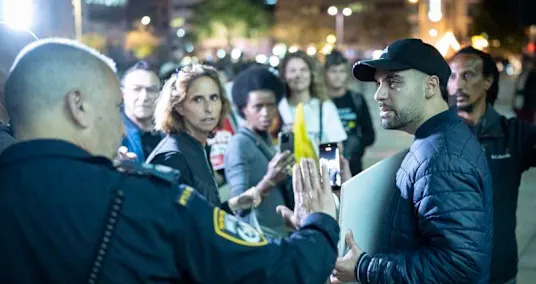
Protests took place in Tel Aviv, Jerusalem, Haifa, and Beersheba, as a survey found broad but uneven support among Jewish Israelis for Operation Roaring Lion.
Israel Police arrested 21 anti-war protesters Saturday night as demonstrations against the conflict with Iran expanded in multiple cities despite restrictions on public gatherings.
Protests took place in Tel Aviv, Jerusalem, Haifa, and Beersheba, with hundreds of participants reported in Tel Aviv and Jerusalem and about 100 in Haifa, marking the largest turnout since weekly demonstrations began. Authorities said 13 people were arrested in Tel Aviv and eight in Haifa.
Police said the gatherings were not approved under Home Front Command regulations that ban events with more than 50 people. Officials said the increase in turnout followed calls by groups opposing the government to protest despite the restrictions.
“During a situation assessment that took place at the scene with a Home Front Command representative… it was clarified that there was a real risk to human life and accordingly, Yarkon [precinct] police commander Tzachi Sharabi ordered the gathering to be dispersed,” police said.
Hadash-Ta’al chairman Ayman Odeh, an Arab lawmaker involved in the protests, criticized the police response, calling officers fascists “in the service of the government” and saying they were afraid of “the heroic citizens who went out, despite everything, to make their voice heard.”

Survey shows broad, uneven support for war
The demonstrations come as a March 2026 survey by the Israel Democracy Institute found broad but uneven support among Jewish Israelis for Operation Roaring Lion. Support was strongest on the Right at 87% and about half on the Left.
The survey also found that Jewish and Arab respondents largely agreed that Iran’s resilience has been stronger than expected. Most Jewish respondents said Israeli society could sustain the campaign for up to one month, while 28% said as long as needed. Arab respondents were less optimistic about how long the public could endure the conflict.
A majority of Jewish respondents said Prime Minister Benjamin Netanyahu’s decision was driven by security considerations, while most Arab respondents viewed it as political.
LATEST POSTS
- 1
 Sports Shoes of 2024: Upgrade Execution and Solace
 - 25 Indoor Plants That Further develop Air Quality
- 3Building a Maintainable Closet: Individual Excursions in Moral Style
- 4Zelensky names spy chief to head presidential office after corruption row
- 5Putting pig organs in people is OK in the US, but growing human organs in pigs is not – why is that?


- Trump signs bill allowing whole milk to return to school lunches
- Outside Lovers' Decision: Favored Climbing Rucksacks
- Well known Tea Brands for Each Tea Sweetheart
- Single women risk rape and exploitation in search for better life in Europe
- Minneapolis ICE shooting live updates: Protests continue over agent's killing of Renee Nicole Good; Walz puts National Guard on standby
- Popular Home Rug Series For You
- 'Stranger Things' character guide: The nerds, the newcomers and the rest of the Season 5 cast
- 'Supergirl' drops 1st teaser trailer: Watch Milly Alcock as Kara Zor-El and the return of Krypto the Superdog
- Dolly Parton misses Dollywood event due to 'a few health challenges' after skipping honorary Oscars


