When Sarah Baldassaro turned 50, she took stock of her health and began working with a fitness coach on strength training, a type of exercise that's crucial for women in midlife.
“Now I would say I’m stronger overall than I ever have been at any age,” said Baldassaro, 52, of Alexandria, Virginia. “My fitness level is much more like when I was in my early 30s.”
Medical experts say strength training keeps bones and muscles healthy after menopause when estrogen loss speeds up a reduction in bone density and contributes to the gradual loss of muscle mass. This type of exercise — which involves working against resistance — also helps women maintain a healthy weight and stay on track with New Year’s resolutions about fitness.
“People underestimate how powerful it is," said Dr. Christina DeAngelis, an OB-GYN at Penn State Health.
But what should your workout look like and how do you get started?
Strength training with weights
Physical therapist Hilary Granat said bone and muscle health are intertwined: When muscle pulls on bone during resistance training, it stimulates bone-building cells.
Resistance can come from dumbbells, free weights or machines such as rowers. One example of a strength training exercise is the chest press, which involves lying back on a bench or the ground, pressing weights up from chest level and then lowering them.
It’s important to work “close to muscle failure,” said Granat, who owns Core Total Wellness in Washington, D.C. “You really have to push yourself.”
That means lifting weights that are heavy enough to be challenging and doing somewhere between six and 30 repetitions.
You’ll know you’re working hard enough if you start slowing down in tempo or speed or can't do another repetition in good form, she said. A good rule of thumb for an exercise like a bicep curl is to lift weights somewhere between 5 pounds (2.3 kilograms) and 20 pounds (9.1 kilograms), with novices starting at the lower end.
Baldassaro has worked her way up to 20 pounds (9.1 kilograms) for some exercises, incorporating techniques she learned from Granat.
She said the health coach has helped her expand her workouts beyond mostly cardio.
While she still does aerobic exercises, "the strength training has really been the difference maker for me,” she said.
No weights? No problem
Building up bones and muscles doesn't necessarily require equipment. You can also do pushups, squats, lunges, situps, crunches or planks. Another good exercise is squatting down with your back against a wall.
Even the simple act of getting into and out of a chair can be helpful, DeAngelis said.
“You have to engage your core going from sitting to standing,” she said. “That also allows you to work on your coordination and balance.”
There's also what Granat calls “impact training" — exercises like walking, hiking, running, jumping, skipping and climbing stairs. On the high-impact end of the spectrum is a “rebound jump,” which involves jumping up and down from a step 10 to 30 times.
“We’re not talking about jumping hard and fast and a lot," she said, adding that three times a week is enough.
Don’t forget about balance
Experts say middle-aged women should also perform balance exercises, which play a crucial role in preventing falls that can break or fracture bones.
These include tai chi, yoga or even standing on one leg while brushing your teeth for around 30 seconds.
All of these exercises are great for younger people too, experts say, especially since bone mass peaks at 25 to 30 years old and slowly begins to lessen around age 40.
After seeing how strength training has improved her life, Baldassaro advises others: “Don't wait. Get started.”
———-
The Associated Press Health and Science Department receives support from the Howard Hughes Medical Institute’s Department of Science Education and the Robert Wood Johnson Foundation. The AP is solely responsible for all content.
LATEST POSTS
- 1
 Venezuelans in Madrid celebrate Maduro's capture
 - 2Sudan war ‘being fought on women’s bodies’: Survivors detail sexual assault
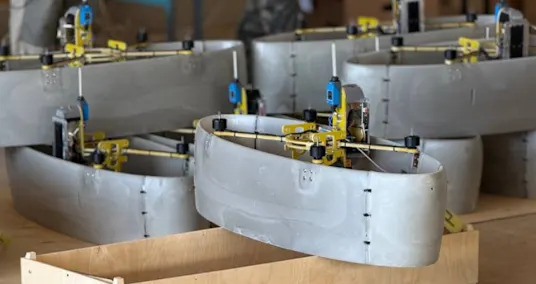
- 3Russia’s New KVS Drone May Be Designed To Restore Reach In The FPV War
- 4Airport wait times won't return to normal until Congress reaches a deal to pay TSA. Here's why they still can't come to an agreement.
- 5The Force of Positive Reasoning: Day to day Attestations




- 5 Advancement Developments in Biotechnology
- Fundamental Home Machines for Improved Solace in Summer
- Find Successful Magnificence Items for Sparkling Skin
- The Following Huge Thing: 5 Progressive Tech New businesses
- Party Urban areas of the World
- Home Wellness Basics: Building Your Home Exercise center
- France honors the victims of the Paris attacks' night of terror 10 years on
- 5 Breakout Stars in Ongoing television Series
- Iran-backed Iraqi militias attack Kurdistan over 450 times since beginning of war